
Crawford Projected Versus Actual Release
A projected or scheduled date is a calculation or legal milestone. An actual release date records an event that staff executed. Pennsylvania’s indeterminate prison sentences usually state a minimum and maximum. The minimum is generally the first point when discretionary parole may occur. It does not require the Parole Board to approve release. The maximum is the judicial outside term, subject to lawful credit, later orders, and other custody.
Pretrial detainees at Crawford County Correctional Facility do not have a sentence-based projected date. Their release may depend on bail, a committing-authority order, disposition, or another court act. CCCF can also release someone from county custody into the hands of another agency. A sentence-end field, parole grant, planned release, and executed release transaction therefore describe four different facts.
Scheduled versus actual: A minimum, maximum, sentence-end, RRRI, or parole date is not proof that the person left custody on that day.
For an actual county departure, ask CCCF Intake/Release for the execution and destination. For a state-prison release, use PA DOC and PA SAVIN, then inspect the Board Action or sentencing docket for the legal basis. The Crawford County released-inmate search covers that post-event verification path.
Find Crawford County Projected Dates
Begin with the custodian. The county jail and PA DOC maintain different calculations, and the Crawford Clerk keeps the court order rather than the executed jail transaction. The current PA DOC public Inmate detail does not expose a projected, tentative, minimum, maximum, or actual release date. That absent field is a key Pennsylvania limitation, so the public locator cannot supply a date it does not show.
- Identify the current custodian through CCCF Intake/Release, PA SAVIN, or the PA DOC locator. A transfer from CCCF into state custody is not community release.
- Open the UJS Crawford County docket and locate the sentencing order. Read the minimum, maximum, credit, concurrent or consecutive terms, and any later amended order.
- For a county sentence, ask CCCF for the maintained sentence-end calculation and ask Intake/Release about actual execution. Use the court record for the source order.
- For a state sentence, ask the institution or PA DOC records office for records sufficient to show the current minimum, maximum, sentence status, and any parole-release date.
- After state release to parole, switch to the Department Supervised Individual/Parolee search. Its release-date field is retrospective, not a forecast for a current prisoner.
- Register through PA SAVIN for a reported custody change, then confirm the event with the agency that held the person.
The PA DOC locator visibly separates Inmate and Parolee or Department Supervised searches:
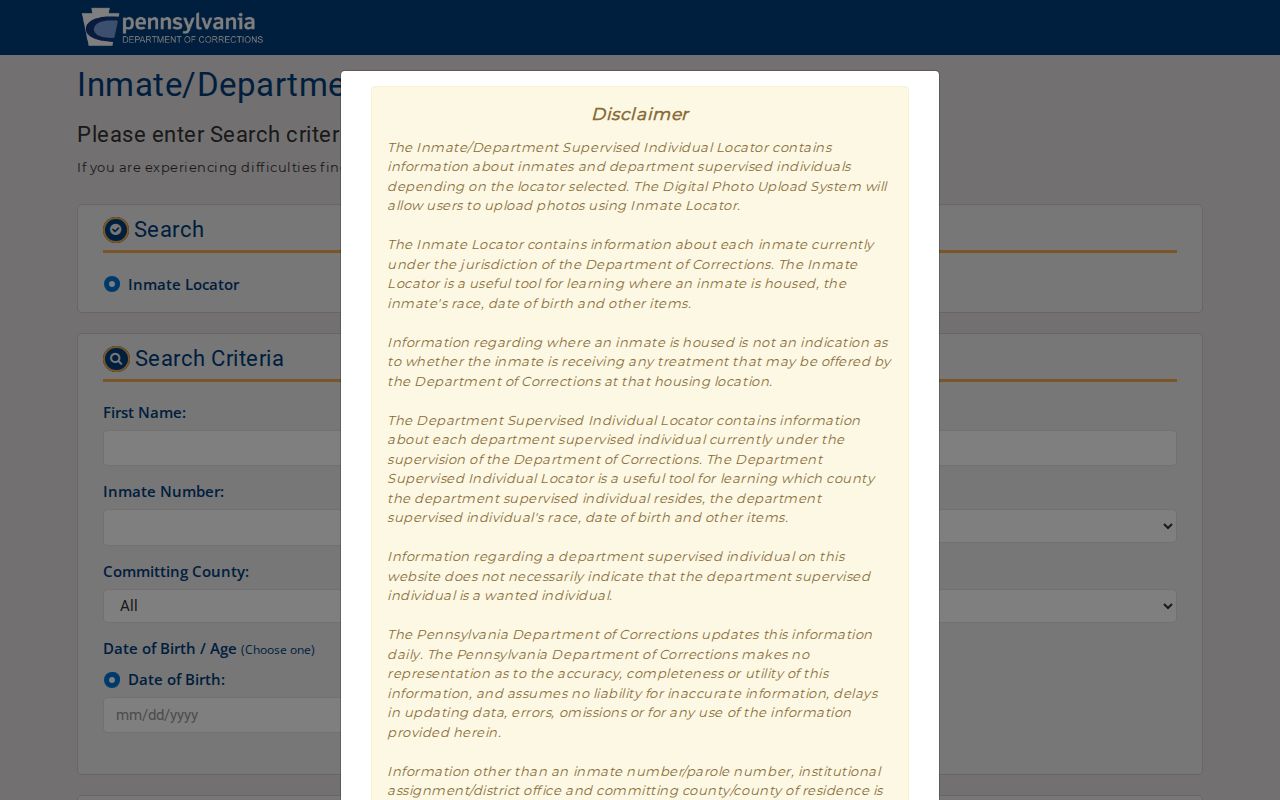
The separate choices matter because a current state prisoner and a person already released to field supervision are not searched in the same way.
Note: PA DOC says its locator updates daily, so an event on release day may occur before the public record changes.
Pennsylvania Release Date Calculations
Under 42 Pa.C.S. § 9756, a sentence of total confinement generally states a minimum and maximum, and the minimum ordinarily cannot exceed one-half of the maximum. This produces an indeterminate range. The minimum opens possible parole review under governing law. The maximum is not a forecast of the day or hour staff will release someone.
Credit for qualifying custody under 42 Pa.C.S. § 9760 may apply to the minimum and maximum. Simply adding the announced term to sentencing day can be wrong. Prior confinement on the same charge, overlapping cases, sentence aggregation, a corrected commitment, an appeal, or recommitment can change the operational computation. The docket supplies the judicial order, while PA DOC or CCCF maintains the working calculation.
Pennsylvania does not impose a general rule that every state prisoner must serve about 85 percent before release. That shorthand comes from a federal framework and should not be applied to a Crawford County or PA DOC sentence. County cases must be read from the order, time-credit calculation, jail record, and any parole or bail action. State parole generally cannot occur before the court minimum under 61 Pa.C.S. § 6137, but reaching that point does not ensure a grant.
Crawford RRRI Release Dates
The Recidivism Risk Reduction Incentive is a specific statutory alternative minimum. It is not universal good time. Eligibility depends on offense and history rules in 61 Pa.C.S. § 4503, and release at the RRRI minimum follows § 4506. The court documents should show whether an RRRI minimum was imposed for an eligible state sentence.
Under 61 Pa.C.S. § 4505(c), an eligible person with an ordinary minimum of three years or less may receive an RRRI minimum equal to three-fourths of that minimum. When the ordinary minimum exceeds three years, the fraction is five-sixths. For a two-to-four-year sentence with an RRRI minimum, three-fourths of the two-year minimum is eighteen months. That is an eligibility point, not a promise of release at eighteen months.
For an eligible four-to-eight-year example, five-sixths of the four-year minimum equals forty months. That fraction is about 83.33 percent of the minimum, not an 85-percent rule applied to the whole sentence. Program completion, Board action, recalculated credit, detainers, and later orders may still control what happens. Never use the example to calculate a named person’s date without the actual sentence records.
Note: RRRI changes a qualifying minimum calculation; it does not turn that milestone into an executed release transaction.
Crawford Release Dates Can Change
A date can move because the legal sentence, the credit calculation, the parole decision, or the receiving custodian changes. Some events shift the calculated point. Others leave the date intact but change whether release is to the community or to another agency. Preserve the exact label and authority instead of reducing every outcome to “released.”
| Factor | Effect on the date or path | Best source |
|---|---|---|
| Amended or appealed order | Can alter the controlling sentence or credit | UJS docket and filed order |
| Prior-custody credit | Can change minimum and maximum calculations | Order plus CCCF or PA DOC computation |
| Parole grant or refusal | May permit release after the minimum or keep confinement in place | Board Action and PA DOC |
| Disciplinary consequence | May affect an applicable program or institutional release step | Institution or DOC record |
| Detainer or new case | May redirect departure into another custodian | Release destination, docket, and receiving agency |
| Revocation or recommitment | Can return a supervised person to custody and change calculation | Board or court action and DOC record |
No Crawford weekend-release rule or fixed release hour was found. A weekend date does not establish a Friday exit. Business-office closure also does not prove that judicially authorized releases stop. For a county case, call Intake/Release about the actual process and timing.
Confirm Crawford County Release Dates
Confirmation needs both a legal and custody source. The docket or Board Action explains why release may occur. CCCF or PA DOC shows whether staff executed the change. PA SAVIN reports a downstream event from a participating agency, and its alert can be useful when a planned date is near. The Crawford County VINELink check explains search, registration, PIN acknowledgment, and limits.
For CCCF, call Intake/Release at 814-333-7300 extension 1816. Ask whether the person remains in Crawford County custody and, if not, whether the departure was release or transfer. For written proof, request the release date and time, authority or type, and destination or receiving agency where recorded and public. The county’s open-records route applies to the CCCF transaction, while court orders belong with the Clerk.
For a PA DOC case, send a narrow request to the DOC Right-to-Know Law Office for records sufficient to show maintained minimum, maximum, parole-release date, sentence status, and supervising district office fields. The office is at 1920 Technology Parkway, Mechanicsburg, PA 17050; phone 717-728-7763; email RA-docrighttoknow@pa.gov. The request should include the DOC number when known.
Final check: Match the planned date to an agency-fed release event, then ask whether another detainer or receiving authority changed the destination.
Crawford County Sentence-End Records
The CCCF public release page says a county prisoner may be paroled by automatic release or court order, but it does not publish a date formula. A current county calculation therefore comes from the commitment, sentencing order, credit record, and jail execution. An old Crawford current-inmate list once carried a sentence-end field, yet that historical field was not proof of actual departure and is not the current public route.
County cases also include paths that are not sentence calculations at all. Bail before disposition depends on the court and bail process. A time-served disposition turns on the filed order and credited custody. Payment of fines and costs may authorize release under the county’s stated routes. County parole changes confinement to supervision. A transfer closes the CCCF custody episode without releasing the person into the community.
Ask for named existing records, not a new prediction. Useful items include the sentencing or commitment order, maintained sentence-end calculation, actual release transaction, release authority, and destination. Under Pennsylvania’s Right-to-Know Law, agencies need not create a new record to answer a question. A narrow record request is more likely to preserve the source facts needed to understand the date.
The release authority matters as much as the date. Crawford’s public instructions distinguish bail arranged through a bondsman, Clerk, or District Court from parole or a committing-authority order, and CCCF says it does not accept bail money. A furlough also requires a judge or magisterial district judge. None of those routes should be converted into a generic good-time formula. Read the court action, then ask whether the jail executed it and whether another hold changed the destination.
Retention is not uniform. The research found no single schedule that governs a CCCF release transaction, PA DOC discharge record, VINE result, court docket, and institutional photo for the same span. For that reason, an older projected-date question should begin with the durable sentencing docket and then move to the agency that maintained the calculation. A missing VINE or locator result does not erase the underlying order or prove that the term ended.
Facility type sets the channel. Crawford County Correctional Facility is the county jail, while State Correctional Institution Cambridge Springs is a PA DOC prison for women located in Crawford County. CCCF cannot certify a Cambridge Springs state-prison discharge. If a case instead enters federal or immigration custody, use BOP or ICE records because neither the county sentence calculation nor the PA DOC locator covers that custody layer.